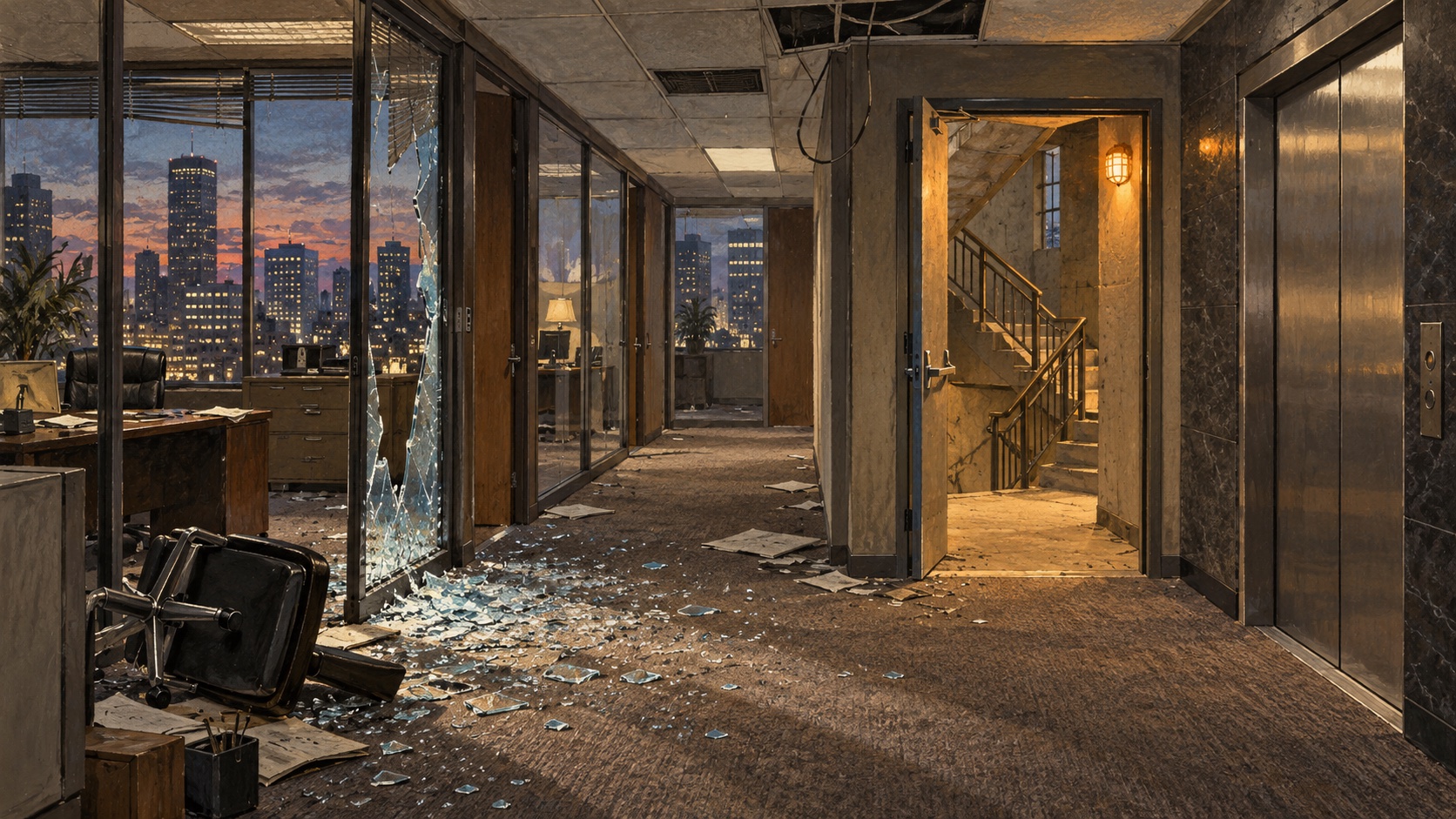
An action scene is easier to follow when the audience understands the space and what makes it dangerous.
Without that understanding, an elaborate action sequence can be difficult to follow. The stunt can be expensive. The camera can shake in all the right places. The edit can cut fast enough to imply danger. Someone can jump, crash, punch, run, shoot, fall, recover, and keep going.
But if the audience does not understand the space, it is hard to judge whether a character is escaping danger or getting closer to it.
A good action scene establishes exits, obstacles, blind spots, and time limits before characters have to act on them.
That is why Die Hard still works as the clean example. Nakatomi Plaza is not just a tall building where action happens. Its layout determines what the characters can do.
Establishing Nakatomi Plaza
The party matters because it establishes the building as social space before it becomes tactical space. Elevators are convenience. Offices are status. The vault is corporate infrastructure. The roof is just the roof.
Then the takeover changes the meaning of every piece.
The elevators become routes and traps. The floors become layers of risk. The roof appears to offer an escape, then becomes dangerous. The vault becomes the real objective. Radios turn distance into conversation. Glass turns a hallway into a weapon.
The script establishes the building, then changes which routes and spaces are safe.
John McClane is not interesting because he is invincible. He is interesting because he does not fully know the building. He is moving through spaces that Hans Gruber thinks he controls. The usefulness and danger of each location keep changing. A stairwell is safe until it is not. A radio is power until it exposes you. A hostage floor is stable until one person is missing. A roof is salvation until it becomes a killing field.
Knowing the layout helps us understand how little time McClane has to act.
Containment is not just geography
Contained action does not mean small. It means rules.
The Nostromo in Alien is a ship, but the ship is not the point by itself. The point is quarantine. A closed door is not just a closed door. It is a moral test. In the Kane airlock sequence, the decision is whether to open the door: if the contaminated body stays outside, the crew has a chance. If the body comes in, everyone aboard is exposed to the danger.
The scene works because safety protocol collides with fear, loyalty, labor, and corporate logic. The conflict concerns who can override the safety rule and put the crew at risk.
Jaws does the same thing in the open air, which is harder. Amity is not a claustrophobic spaceship. It is a town, a beach, a season, a tourism economy, a mayor, a police chief, and officials reluctant to acknowledge a threat to tourism. The shark works before it is seen because the town is built to disbelieve danger.
The beach is geography, but the pressure is civic. Where can people swim? What can be closed? Who has authority? What counts as evidence? What would closing the beach cost this weekend?
That is why the first half of Jaws is not filler before the boat. It establishes why the town has failed to protect people. By the time the movie moves onto the Orca, the characters must deal with the shark while relying on limited equipment and conflicting judgments, far from help.
Jurassic Park earns its spectacle the same way. The park is sold as control: fences, locks, tour cars, maps, paddocks, visitor routes, command rooms, and protocols. Then the storm and Nedry’s sabotage disable the systems visitors depend on for protection. The T. rex attack is not only a dinosaur set piece. It works because the movie has already established the importance of the fence, the stalled cars, the glass, the mud, the drop, the missing radio contact, and the staff’s mistaken confidence in their control of the park.
Architecture and authority
The best version of this idea is not limited to traditional action movies.
Parasite uses a house to show differences in wealth and power. Stairs, windows, smell, rain, and basement access are not production design decoration. They show how differently the residents and workers experience the same place, and who has privacy, comfort, and protection.
When the basement is revealed, the house does not simply gain a new location. We have to reconsider who lives there, who depends on the owners, and what the visible rooms conceal.
The Menu does it with service. Hawthorn is a restaurant, but each course advances the plot. Each course teaches a new rule. Each ritual makes it harder for the guests to leave. The room starts as luxury and becomes containment. Service becomes surveillance. The chef’s authority is not abstract; it is built into where people sit, when food arrives, who may leave, and how the staff acts together.
Worldbuilding helps the audience understand the rules that constrain the characters.
The rules of a place become dramatic when violating or obeying them has consequences.
Teaching the audience the mission
Top Gun: Maverick is useful because it is so explicit about this. The mission works because the movie makes the audience rehearse it before the final run.
Altitude. Turns. Target. Climb. G-force. Timing. Wingman survival. The impossible route is explained so many times that by the end we are not just watching jets go fast. We are reading the attempt against rules we understand.
That is why the final sequence has pressure. We know what too high means. We know what too slow means. We know what missing the climb means. We know why one pilot’s success can still doom another pilot. The unlikely success is satisfying because we understand what the pilots had to accomplish.
Bad spectacle skips that step. It adds scale without establishing what the audience needs to understand. More vehicles. More debris. More bodies. More cuts. More money on screen. None of that matters if the viewer cannot tell what changed.
The audience needs to recognize progress, setbacks, and danger.
Scripts are systems
Plot summary flattens this into what happens. Script analysis should be able to show how the pressure is built.
A script is not just dialogue and scene order. It establishes what characters can attempt and what they risk. It tells you what the arena is, which institution controls it, what rule gets violated, what the cost is, which entrance changes the room, when a safe location becomes dangerous, and what the audience has to learn before a reversal makes sense.
That is the direction of the OverBlack work: scripts as systems you can query by craft function, not just title, decade, genre, or writer.
Can I find scenes where a house becomes an institution? Where a route must be completed within a time limit? Where a body becomes evidence? Where service gives one character control over another? Where evidence of danger conflicts with a town’s economic interests? Where a mission briefing prepares the audience to follow a later action sequence?
That is more useful to me than another archive of famous lines. Lines matter. Plot matters. But craft often lives in the relations between place, rule, pressure, and cost.
The test
Can you describe the location’s rules before an action scene changes them?
Where are we? Who controls access? Which route is safe? What happens if a door opens or stays shut? What becomes harder as time passes?
If the script answers those questions, the audience can understand why a character’s next move matters. That understanding gives the stunt, chase, or escape its suspense.